
Toy Blaster Safety Guide for Parents: Everything You Need to Know
Toy blasters have become one of the most popular categories of children’s outdoor and indoor toys, offering active play, teamwork, and skill-building opportunities. However, as with any toy that involves projectiles, toy blaster safety is a topic every parent should understand before making a purchase. This comprehensive guide walks you through everything from the different types of toy blasters and their safety profiles to age-appropriate recommendations, protective gear, storage, and common misconceptions.
Why Toy Blaster Safety Matters
According to the U.S. Consumer Product Safety Commission (CPSC), toy-related injuries send tens of thousands of children to emergency rooms each year, and projectile toys account for a notable share of eye and facial injuries. While modern toy blasters are designed with safety features, the risk of injury increases significantly when children use them without proper supervision, protective equipment, or an understanding of safe play rules.
The good news is that the vast majority of toy blaster injuries are preventable. By understanding how different blaster types work, choosing age-appropriate models, enforcing clear usage rules, and investing in basic protective gear, parents can ensure that blaster play remains fun and safe.
Types of Toy Blasters and Their Safety Profiles
Not all toy blasters are created equal. Each type operates on a different mechanism and uses different ammunition, which directly affects its safety profile. Below is a detailed breakdown of the four most common categories.
1. Foam Dart Blasters
Foam dart blasters fire lightweight foam projectiles using spring-loaded or motorized air pressure systems. The darts are typically made of soft foam with rubber or silicone tips, making them the gentlest option for younger children. Most foam dart blasters operate at relatively low muzzle velocities, reducing the risk of injury on impact.
Popular models like the Electric Foam Dart Gun feature dual-mode firing (semi-automatic and burst modes) and are suitable for children aged 8 and up with proper supervision. Similarly, the Fire Phoenix Soft Bullet Pistol is designed as a compact sidearm that uses soft foam bullets, making it an excellent entry-level option for younger blaster enthusiasts.
2. Gel Blasters
Gel blasters use water-absorbent polymer beads (often called “gellets” or “gel balls”) as ammunition. These beads are non-toxic, biodegradable, and burst upon impact, leaving no residue and causing minimal sting. Gel blasters typically operate at higher velocities than foam dart guns but lower than airsoft or paintball markers.
Models such as the P90 Gel Blaster offer realistic styling with submachine-gun aesthetics while maintaining toy-grade safety standards. The gel ammunition disintegrates on contact, which significantly reduces the risk of bruising compared to solid projectiles. However, eye protection is mandatory with gel blasters, as the higher muzzle velocity can cause serious eye injury if a shot lands directly.
3. Water Guns
Water guns are the safest category of blaster toys, firing only streams of water. They carry virtually no risk of impact injury, though motorized models can produce surprising range and pressure. The MK6 Electric Water Gun is a battery-powered automatic model that delivers sustained water streams, making it ideal for summer outdoor play. The primary safety consideration with water guns is ensuring play occurs in open areas away from slippery surfaces and electrical equipment.
4. Shell-Ejecting and Realistic Toy Guns
Shell-ejecting toy blasters add a layer of mechanical realism by simulating the shell ejection process of real firearms. The M200 Sniper is a bolt-action model that ejects shells with each cycle, providing an immersive play experience. The 357 Revolver Toy Blaster replicates the classic revolver design while firing soft darts.
While these models use safe foam or soft-bullet ammunition, their realistic appearance requires extra caution. Parents should teach children never to bring realistic-looking toy guns into public spaces or point them at strangers or law enforcement, as this can create dangerous misunderstandings.
Comparison Table: Safety Features by Blaster Type
| Blaster Type | Ammunition | Impact Risk | Min. Age | Eye Protection Required | Key Safety Advantage |
|---|---|---|---|---|---|
| Foam Dart | Soft foam darts | Low | 6+ | Recommended | Softest projectiles; lowest velocity |
| Gel Blaster | Water-absorbent gel balls | Moderate | 8+ | Mandatory | Ammo bursts on impact; biodegradable |
| Water Gun | Water stream | Very Low | 4+ | Optional | No projectile; zero impact injury risk |
| Shell-Ejecting | Soft foam bullets / darts | Low–Moderate | 8+ | Recommended | Bolt-action rate of fire limits rapid shots |
Age Recommendations: Choosing the Right Blaster
Age appropriateness is one of the most important factors in toy blaster safety. Manufacturers provide age recommendations based on the toy’s power, complexity, and projectile type. Here is a general guideline:
- Ages 4–6: Water guns and low-velocity foam dart blasters with large, easy-to-handle darts. Avoid motorized or gel-based models.
- Ages 6–8: Spring-powered foam dart blasters and simple soft-bullet pistols. Adult supervision recommended during play.
- Ages 8–12: Electric foam dart blasters, gel blasters (with eye protection), and shell-ejecting models. Begin teaching safe handling habits.
- Ages 12+: Most toy blaster types are appropriate with established safety practices. Reinforce rules about public use and realistic-looking models.
It is important to note that age recommendations are guidelines, not guarantees. A child’s maturity, coordination, and ability to follow rules should also factor into your decision.
Essential Protective Gear
Regardless of the blaster type, investing in basic protective gear dramatically reduces the risk of injury. The following items are recommended for all blaster play:
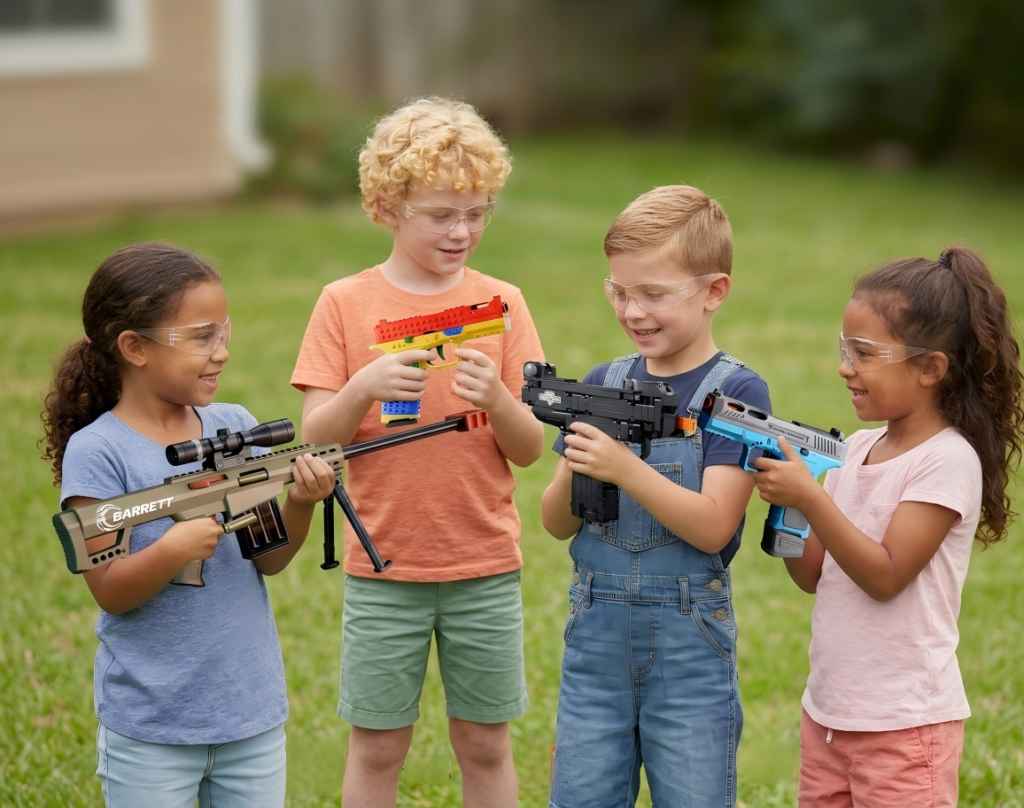
- Impact-rated safety goggles or glasses: The single most important piece of protective equipment. Look for ANSI Z87.1-rated eyewear that provides full peripheral coverage. Standard sunglasses are not a substitute.
- Long-sleeved clothing: Helps reduce the sting of gel ball and foam dart impacts on bare skin.
- Closed-toe shoes: Prevents foot injuries from running on rough terrain or stepping on dropped ammunition.
- Gloves (optional): Provides grip and protects hands during extended play sessions, especially with gel blasters that may leave minor welts.
- Face mask (for gel blasters): A paintball-style face mask offers full-face protection and is strongly recommended for gel blaster play.
POPLAYO recommends that all customers purchasing gel blasters or high-velocity foam dart guns also acquire appropriate eye protection before use.
Safe Usage Rules Every Family Should Follow
Establishing clear ground rules before blaster play begins is one of the most effective ways to prevent accidents. Consider adopting the following rules in your household:
- Never aim at faces or eyes. This is the golden rule of blaster safety. Even at low velocities, a direct hit to the eye can cause permanent damage.
- Never point at people who are not playing. Bystanders, pets, and passersby should never be targeted.
- Do not modify the blaster. Removing air restrictors or modifying springs can dramatically increase muzzle velocity and create dangerous projectiles.
- Use only manufacturer-approved ammunition. Aftermarket darts or gel balls may be harder, denser, or improperly sized, increasing injury risk.
- Treat every blaster as if it is loaded. Instilling this habit early builds responsible handling that carries into adulthood.
- Establish a designated play area. Avoid playing near roads, parking lots, or areas with fragile objects.
- Never bring realistic-looking toy guns into public. This is critical for safety, as realistic toy firearms can be mistaken for real weapons.
Storage and Maintenance Tips
Proper storage is an often-overlooked aspect of toy blaster safety. When not in use, blasters should be stored unloaded in a secure location out of reach of younger children. Here are some best practices:
- Store ammunition separately from the blaster to prevent unsupervised use.
- Remove batteries from electric models during long-term storage to prevent corrosion and accidental activation.
- Keep gel blaster beads in their hydrated form in a sealed container, or store them dry and hydrate before use.
- Clean the barrel and internal mechanisms periodically with a dry cloth to remove dust and debris that can affect performance.
- Inspect darts and gel balls for damage before each use. Damaged ammunition should be discarded.
Common Misconceptions About Toy Blaster Safety
“Foam darts can’t hurt anyone.”
While foam darts are the safest projectile type, they can still cause pain, bruising, or eye injury at close range or when fired from modified blasters. Eye protection should always be worn, even with foam dart guns.
“Gel blasters are the same as airsoft guns.”
This is incorrect. Gel blasters fire water-based polymer beads that burst on impact, while airsoft guns fire hard plastic BBs at significantly higher velocities. Gel blasters produce less impact force and are generally classified as toys, whereas airsoft guns are often regulated more strictly.
“Water guns are completely risk-free.”
While water guns pose negligible projectile risk, motorized models can produce high-pressure streams that may surprise young children. Additionally, water play on slippery surfaces creates fall hazards. Always supervise water gun play and choose appropriate play areas.
“If it’s sold as a toy, it must be safe for all ages.”
Toy blasters are tested and rated for specific age ranges. A blaster safe for a 12-year-old may not be appropriate for a 6-year-old. Always check the manufacturer’s age recommendation and use your own judgment based on your child’s developmental stage.
Frequently Asked Questions
1. At what age is it safe for children to start playing with toy blasters?
Most safety experts recommend introducing toy blasters at age 6 or older, starting with low-velocity foam dart models or water guns. Children under 6 may lack the coordination and impulse control needed to follow safety rules consistently. Always check the manufacturer’s age rating on the packaging.
2. Do gel blasters hurt more than foam dart guns?
Gel blasters typically operate at higher muzzle velocities than foam dart guns, so the impact can feel more intense. However, gel balls burst on contact and dissipate energy quickly, which reduces the risk of bruising compared to solid projectiles. Wearing appropriate clothing and protective gear minimizes any discomfort.
3. Is eye protection really necessary for foam dart blasters?
Yes. While foam darts are soft, a direct impact to the eye at close range can cause corneal abrasions or more serious injuries. ANSI Z87.1-rated safety goggles are strongly recommended for all types of blaster play, including foam dart guns.
4. Can I let my child play with a toy blaster in a public park?
This depends on local regulations and the type of blaster. Foam dart guns and water guns are generally acceptable in open public spaces, but gel blasters and realistic-looking models may be restricted or prohibited. Always check local laws, avoid pointing at non-participants, and use blasters with bright colors or orange tips to clearly identify them as toys.
5. How should I store gel blaster beads safely?
Store dry gel beads in a sealed container away from moisture until ready for use. To hydrate, soak them in water for 4–6 hours. Once hydrated, keep them in an airtight container to prevent drying out. Keep all beads away from children under 3, as they pose a choking hazard.
Conclusion
Toy blaster safety is not about eliminating risk entirely — it is about managing it intelligently so that children can enjoy active, imaginative play without unnecessary danger. By understanding the differences between blaster types, choosing age-appropriate models, enforcing clear safety rules, and investing in protective gear, parents can create a safe and enjoyable blaster play environment.
POPLAYO is committed to providing high-quality, safety-tested toy blasters for children and hobbyists alike. Explore our full range of foam dart blasters, gel blasters, and water guns to find the right blaster for your family’s needs.